

BOOKS
V. Vadi, Cultural Heritage in International Economic Law (Leiden: Brill 2023), 523 pages, ISBN 978-90-04-34781-6 (hardback); ISBN 978-90-04-34782-3 (e-book), Open Access
Can cultural heritage be adequately protected vis-à-vis economic globalization? This book investigates whether and how international economic law governs cultural
phenomena by mapping the relevant legal framework, discussing the relevant disputes concerning cultural elements adjudicated before international economic ‘courts’ (namely the World Trade Organization
adjudicative bodies and investment treaty arbitral tribunals), and proposing legal methods to reconcile cultural and economic interests. It thus provides a comprehensive evaluation of possible solutions, including evolution of the law through treaty interpretation and reforms, to improve the balance between economic governance and cultural policy objectives.
V. Vadi, War and Peace—Alberico Gentili and the Early Modern Law of Nations (Leiden: Brill 2020) 592 pages, ISBN 9789004426030
This treatise investigates the emergence of the early modern law of nations, focusing on Alberico Gentili’s contribution to the same. A religious refugee and Regius Professor at the University of Oxford, Alberico Gentili (1552–1608) lived in difficult times of religious wars and political persecution. He discussed issues that were topical in his lifetime and remain so today, including the clash of civilizations, the conduct of war, and the maintenance of peace. His idealism and political pragmatism constitute the principal reasons for the continued interest in his work. Gentili’s work is important for historical record, but also for better analysing and critically assessing the origins of international law and its current developments, as well as for elaborating its future trajectories.
- Reviewed by Mariangela La Manna for the Italian Yearbook of International Law (2022): As the title suggests, War and Peace is a very robust piece of scholarly work. In fact, not only does it share the title of Lev Tolstoj’s masterpiece, but also its sheer size. Though falling short of reaching the roughly 1500 pages the latter boils down to, Vadi’s War and Peace nonetheless amounts to 500 pages, regrouped under 8 solid chapters. More interestingly, the title appears to be relevant also in merit-based terms, as it points out in a very clear-cut manner the relevance of Gentili’s work not only for the law of war, but also for the law to be applied in peacetime … With a razor-sharp analytical mindset and a neat approach, liberated of any ideological hindrances or biases … Vadi is no apologist; far from it, she acknowledges the many ambiguities, inconsistencies and the frequent lack of clarity in Gentili’s writing and assesses such features in a very dry and objective manner…The pleasantness of the reading … does not hinder in the least the seriousness and credibility of a very mature and grounded study. The underlying research effort is solid and nothing short of impressive: a 52 page bibliography, built over years and years of work in libraries and research centres all over the world.’
- Reviewed by Edward Guntrip for the 22 Melbourne Journal of International Law (2021): ‘War and Peace navigates the methodological challenges of conducting historical studies in international law to very good effect… Overall, War and Peace is well written and clearly structured, and Vadi consistently draws on the chosen themes to better understand Gentili’s works. The monograph evidences extensive archival research, including some materials that have been accessed for the first time. Vadi’s own translations of Gentili’s works in Latin ensure that his voice is present throughout the monograph. Although Vadi aims to present the material on Gentili in a manner that leaves the reader with the final decision as to Gentili’s worldview, there are times where Vadi’s preferred conclusion becomes apparent. Nonetheless, … Vadi remains open to opposing viewpoints throughout her discussions. Given these attributes, War and Peace will become a key reference point for those seeking to better understand Alberico Gentili’s life and his contribution to the modern law of nations.’
V. Vadi, Proportionality, Reasonableness, and Standards of Review in International Investment Law and Arbitration (Cheltenham, UK: Edward Elgar 2018) 316 pages, ISBN 978-1-785368578
International investment law is one of the most dynamic fields of international law, and yet it has been criticised for failing to strike a fair balance between private and public interests. In this valuable contribution to the current debate, Valentina Vadi examines the merits and pitfalls of arbitral tribunals’ use of the concepts of proportionality and reasonableness to review the compatibility of a state’s regulatory actions with its obligations under international investment law.
- Reviewed by Andrea Sesin-Tabarelli for the 36 ASA (Swiss Arbitration Association) Bulletin 3/2018, 808: ‘The book offers a useful conceptual framework for policy makers, practitioners and scholars interested in the legitimacy and effectiveness of investment arbitration’.
- Reviewed by David Collins for the 25(1) International Trade Law & Regulation (2019) 65–67: Of all the many books and articles written of late on the topic of proportionality and/or standards of review in international investment arbitration, this one is the best. Professor Vadi manages to orchestrate a complex assortment of sources from across a range of sub-disciplines including trade, human rights and general public international law, combined with an all-embracing review of the now extensive literature and growing body of case law. In so doing, she delivers a fresh perspective on the well-trodden field of methods of interpretation within investment arbitral practice by drawing upon the tension between public and private law adjudication and by challenging constitutional analogies. Her writing style is a study in clarity and deftness of organisation, making sense where others would have only worsened the muddled complexity of the jurisprudence.’ … These are vital and often unexplored matters in a field where scholarship tends to focus extensively on the case law. … Vadi is one of the world’s foremost commentators in the important field of international investment law, and this book is among her greatest contributions, offering an insightful and comprehensive overview of a subject which has attracted much attention from the academic world and practitioners alike in recent years. She is also a singularly gifted writer—there is no one, at least in academia, who can explain complex concepts as clearly and who can marshal original arguments as skilfully. Proportionality, Reasonableness and Standards of Review in International Investment Law and Arbitration is a book which will quickly become a leading resource and will be a source of many references as well as inspiration in others for years to come.’
- Reviewed by Marcin Menkes, European Yearbook of International Economic Law (2019) 457-462: ‘Valentina Vadi, Professor at Lancaster University Law School is a prolific author who skillfully combines different fields of international law with international investment law… Vadi’s well established reputation in studies of the interaction of other fields of law with international investment law is acknowledged…. This time she invites us for another cross-country journey… the entire book is very well structured… I appreciate original contribution to the debate in a form of much interesting and much needed … narrative. Vadi’s book charts the development of IIL [international investment law] and as such it certainly can inspire the reader to look at the problem at hand from new angles and to broaden one’s perception.’
Valentina Vadi, Analogies in International Investment Law and Arbitration (Cambridge: Cambridge University Press 2016) 320 pages, ISBN 978-1-107-09331-7;
Although investment treaty arbitration has become the most common method for settling investor-state disputes, some scholars and practitioners have expressed concern regarding the magnitude of decision-making power allocated to investment treaty tribunals. Many of the recent arbitral awards have determined the boundary between two conflicting values: the legitimate sphere for state regulation in the pursuit of public goods, and the protection of foreign private property from state interference. Can comparative reasoning help adjudicators in interpreting and applying broad and open-ended investment treaty provisions? Can the use of analogies contribute to the current debate over the legitimacy of investor-state arbitration, facilitating the consideration of the commonweal in the same? How should comparisons be made? What are the limits of comparative approaches to investment treaty law and arbitration? This book scrutinises the impact a comparative approach can have on investment law, and identifies a method for drawing sound analogies.
- Reviewed by Niccoló Ridi for the British Yearbook of International and Comparative Law (2017): ‘There is much to be praised in this book. Its claims, supported by ample and accurate research, are compelling and its approach is quite innovative, as it goes beyond an investigation of the concept of analogy in international legal reasoning, rather focusing on how such analogical and comparative reasoning are to take place in the context of international investment arbitration … [T]his is a timely and valuable study, which will appeal to both practitioners and scholars alike. Through a masterfully crafted analysis, Vadi guides the readers through the intricacies of this topic, investigating the tensions between the concept of legal culture and the ‘invisible college of international lawyers’, and ultimately reminding international lawyers that the use of analogies and paradigms … has implications of considerable magnitude.’
Valentina Vadi, Cultural Heritage in International Investment Law and Arbitration (Cambridge/New York: Cambridge University Press 2014) 344 pages, ISBN 978-1-10-703848-6 foreword by Professor Bruno de Witte (Professor of EU law at the European University Institute and Maastricht University) [also in paperback edition ISBN: 9781316603475];
Can states adopt protectionist cultural policies? What are the limits, if any, to state intervention in cultural matters? A wide variety of cultural policies may interfere with foreign investments, and a tension therefore exists between the cultural policies of the host state and investment treaty provisions. In some cases, foreign investors have claimed that cultural policies have negatively affected their investments, thereby amounting to a breach of the relevant investment treaty. This study maps the relevant investor-state arbitrations concerning cultural elements and shows that arbitrators have increasingly taken cultural concerns into consideration in deciding cases brought before them, eventually contributing to the coalescence of general principles of law demanding the protection of cultural heritage.
- Reviewed by Lucas Lixinski for the Netherlands International Law Review (Vol. 61, No. 3, 2014): ‘Vadi tells the story of how non-legal (economic) considerations could benefit from taking into account more of the law in this area, alongside its well-established values … equipped with a wonderfully rich set of cases … [this volume] will be influential in shaping the field for years to come.’
- Reviewed by Loes Veldpaus for the Journal of Cultural Heritage Management and Sustainable Development (Vol. 5, No. 3, 2015): ‘This book very clearly and thoroughly discusses the legal aspects of foreign investment in a context of (urban) development, in relation to international cultural (heritage) law. A valuable analysis is undertaken to further the understanding of the state-of-the-art, showing how international cultural law potentially clashes with international investment law. Vadi reveals that, as the latter is generally more sophisticated, investment treaty tribunals more and more adjudicate cases that include elements of cultural and heritage value. Interestingly, in such cases arbitrators, in addition to pure economic value, increasingly take cultural value into account. The question remains if investment tribunals are the best places to settle disputes on cultural heritage – probably not. … Vadi concludes with a call for both international investment law and international cultural law to reflect the interest and values of a much wider range of stakeholders.’
- Reviewed by Sebastian Green Martinez for the Israel Law Review (Vol. 50, 2017): ‘Through thought-provoking scenarios and forward-looking proposals, Vadi encourages the improvement of cultural governance. She clarifies the current status of public international law on the subject and presents valuable and clearly explained tools that are now at the disposal of investment arbitrators, practitioners, public officials, diplomats and researchers.’
- Reviewed by Panayotis Protopsaltis for the Journal of International Arbitration (Vol. 35, 2018): 267–274: ‘[the author] present[s] a notably well-written critical overview of the current international law rules on investors’ protection’ and ‘examines the interplay between cultural policies and the protection of foreign direct investors …, while providing a systematic and comprehensive survey of the existing relevant arbitral case law.’
Vadi, Public Health in International Investment Law and Arbitration (London: Routledge 2012) 224 pages, ISBN 978-0-415-50749-3, foreword by Professor Francesco Francioni (Emeritus Professor of International Law at the European University Institute) [also in paperback edition ISBN 9781138025233];
Is a State free to adopt measures to protect the public health of its citizens? If so, what are the limits, if any, to such regulatory powers? This book addresses these questions by focusing on the clash between the regulatory autonomy of the state and international investment governance. As a wide variety of state regulations allegedly aimed at protecting public health may interfere with foreign investments, a tension exists between the public health policies of the host state and investment treaty provisions. Under most investment treaties, States have waived their sovereign immunity, and have agreed to give arbitrators a comprehensive jurisdiction over what are essentially regulatory disputes. Some scholars and practitioners have expressed concern regarding the magnitude of decision-making power allocated to investment treaty tribunals.
This book contributes to the current understanding of international investment law and arbitration, addressing the fundamental question of whether public health has and/or should have any relevance in contemporary international investment law and policy. With a focus on the ‘clash of cultures’ between international investment law and public health, the author critically analyses the emerging case law of investment treaty arbitration and considers the theoretical interplay between public health and investor rights in international investment law. The book also explores the interplay between investment law and public health in practice, focusing on specific sectors such as pharmaceutical patents, tobacco regulation and environmental health. It then goes on to analyze the available means for promoting consideration of public health in international investment law and suggests new methods and approaches to better reconcile public health and investor rights.
- Reviewed by Michele Potestà for the European Journal of Risk Regulation (No. 3, 2013, 419–421): ‘The recent book by Valentina Vadi is a welcome contribution which fills a significant gap in legal scholarship, and which situates itself within those works aimed at exploring the “investment-and” problematics … In this sense, Dr. Vadi’s book could not have been more timely … The author makes a thorough analysis of the legal sources and case law, and suggests a number of methods and approaches to promote greater consideration of public health in international investment law … Public Health in International Investment Law and Arbitration is an original, well-researched and engagingly written book, in which the author challenges conventional wisdoms within the investment law field. One of the strengths of the book is its multidisciplinary approach. Rather than confining herself to a purely investment law analysis, Vadi looks also at the international law on public health and the relating literature, as well as at works from other social sciences, including economics, political science, sociology and behavioral studies. Within the international legal field, she shows to be at great ease in traversing different legal regimes (trade, public health, human rights). The critical analysis and thorough comparison of the jurisprudence of the dispute settlement bodies in the different fields is of particular interest … Valentina Vadi’s book provides a comprehensive analysis of the interplay between international investment law and public health and will thus become a valuable reference in the investment law literature … It will also provide a most useful tool for practitioners and arbitrators involved in investment disputes having a public health dimension. In an area where the risk of falling in excessive specialism and of drowning in technicalities is high, Vadi achieves to always discuss the issues at stake against their wider international law background, with a solid mastery of the wealth of topics discussed and a firm vision of the broader picture.’
- Reviewed by Luciana Borges for the Revista de Iniciaçao científica em relaçoes internacionais (2015) 73–80 (in Portuguese).
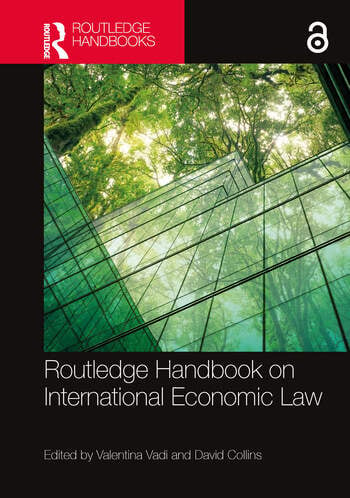
V. Vadi and D. Collins (eds) Routledge Handbook on International Economic Law (London: Routledge 2025), ISBN 9781032507972, 540 pages
The Routledge Handbook on International Economic Law presents a broad, clear, and accessible overview of international economic law. It consists of contributions from leading scholars and rising stars in the field from across the globe.
The Handbook comprises five main parts. Part I deals with the history and theory of the discipline. Parts II, III, and IV deal with the main substantive areas of international economic law: international trade law, international investment law, and international financial and monetary law. Part V explores the link between international economic law and other international legal regimes, such as environmental law and human rights law, highlighting areas where tensions may occur between economic liberalization, sovereignty, and other concerns.
The Handbook investigates international economic law’s theory, policy, and practice from various perspectives. Its 31 chapters highlights central themes that have driven the development of this dynamic subject, reflecting the field as it exists now, while also serving as a point of departure for future studies. The book will provide a solid resource for scholars, students, policymakers, and practitioners in international law, international relations, political science, and economics.
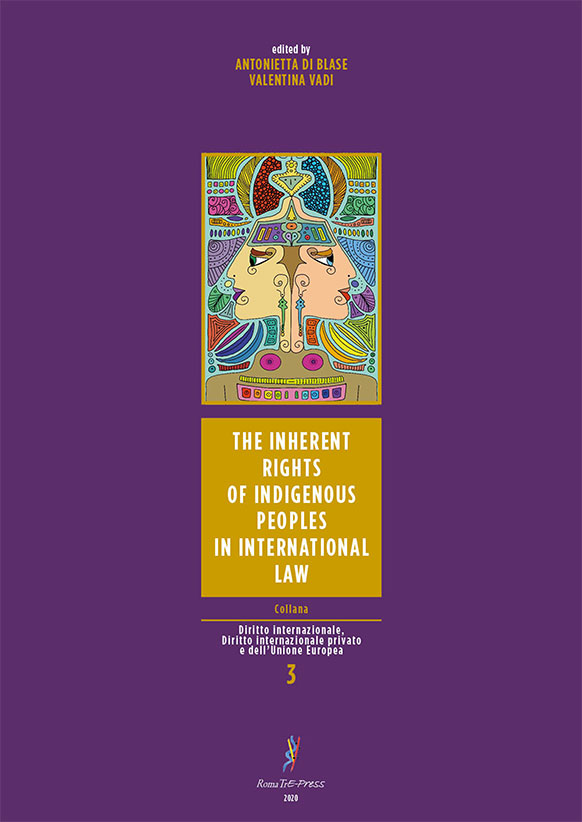
A. Di Blase and V. Vadi (eds)The Inherent Rights of Indigenous Peoples in International Law (Rome: University of Rome III 2020), 327 pages, ISBN 9788832136920
This book highlights the cogency and urgency of the protection of indigenous peoples and discusses crucial aspects of the international legal theory and practice relating to their rights. These rights are not established by states; rather, they are inherent to indigenous peoples because of their human dignity, historical continuity, cultural distinctiveness, and connection to the lands where they have lived from time immemorial. In the past decades, a new awareness of the importance of indigenous rights has emerged at the international level. UN organs have adopted specific international law instruments that protect indigenous peoples. Nonetheless, concerns persist because of continued widespread breaches of such rights. Stemming from a number of seminars organised at the Law Department of the University of Roma Tre, the volume includes contributions by distinguished scholars and practitioners. It is divided into three parts. Part I introduces the main themes and challenges to be addressed, considering the debate on self-determination of indigenous peoples and the theoretical origins of ‘indigenous sovereignty’. Parts II and III explore the protection of indigenous peoples afforded under the international law rules on human rights and investments respectively. Not only do the contributors to this book critically assess the current international legal framework, but they also suggest ways and methods to utilize such legal instruments towards the protection, promotion and fulfi lment of indigenous peoples’ rights, to contribute to the maintenance of peace and the pursuit of justice in international relations.
Valentina Vadi and Bruno De Witte (eds.) Culture and International Economic Law (London and New York: Routledge 2015) 258 pages, ISBN 978-0-415-72326-8 [also in paperback edition (2016) ISBN 9781138281622];
Globalization and international economic governance offer unprecedented opportunities for cultural exchange. Foreign direct investments can promote cultural diversity and provide the funds needed to locate, recover and preserve cultural heritage. Nonetheless, globalization and international economic governance can also jeopardize cultural diversity and determine the erosion of the cultural wealth of nations. Has an international economic culture emerged that emphasizes productivity and economic development at the expense of the common wealth?
This book explores the ‘clash of cultures’ between international law and international cultural law, and asks whether States can promote economic development without infringing their cultural wealth. The book contains original chapters by experts in the field. Key issues include how international courts and tribunals are adjudicating culture–related cases; the interplay between indigenous peoples’ rights and economic globalization; and the relationships between culture, human rights, and economic activities.
The book will be of great interest and use to researchers and students of international trade law, cultural heritage law, and public international law.
- Reviewed by Walther Michl for the European Yearbook of International Economic Law (2016), 803–810: ‘The particular added value of the book as compared to other academic works is that it provides a comprehensive overview over a broad variety of issues arising at the interface between culture and international trade. The main factor contributing to its high quality is the choice of distinguished authors who had had previous experience in the field they treated. Moreover, the contributions fit well together within the different parts of the volume so that redundancies and duplications are largely avoided. An asset of particular value is the inclusion of generous bibliographies at the end of each article, which provide excellent guidance for further readings. The volume is of particular interest to all academics that are looking for a reliable starting point for further investigations in the area of trade and culture.’
Valentina Vadi and Hildegard Schneider (eds.) Art, Cultural Heritage and the Market: Ethical and Legal Issues (Heidelberg: Springer 2014), 342 pages, ISBN 978-3-642-45094-5 [also in paperback edition ISBN 9783662511510];
In the age of economic globalisation, do art and heritage matter? Once the domain of elitist practitioners and scholars, the governance of cultural heritage and the destiny of iconic artefacts have emerged as the new frontier of international law, making headlines and attracting the varied interests of academics and policy-makers, museum curators and collectors, human rights activists and investment lawyers and artists and economists, just to mention a few. The return of cultural artefacts to their legitimate owners, the recovery of underwater cultural heritage and the protection and promotion of artistic expressions are just some of the pressing issues addressed by this book.
Contemporary intersections between art, cultural heritage and the market are complicated by a variety of ethical and legal issues, which often describe complex global relations. Should works of art be treated differently from other goods? What happens if a work of art, currently exhibited in a museum, turns out to have originally been looted? What is the relevant legal framework? What should be done with ancient shipwrecks filled with objects from former colonies? Should such objects be kept by the finders? Should they be returned to the country of origin? This book addresses these different questions while highlighting the complex interplay between legal and ethical issues in the context of cultural governance. The approach is mainly legal but interdisciplinary aspects are considered as well.
SPECIAL ISSUES
- V. Vadi and S. Woldeab Andemariam (eds.) Special Issue on The African Renaissance and International Cultural Heritage Law, International Journal of Cultural Property (2025);
- V. Vadi and H. Schneider (eds.), Special Issue on The New Frontiers of Cultural Law: Intangible Heritage Disputes, 11(2) Transnational Dispute Management (2014) ISSN 1875-4120;
- V. Vadi and H. Schneider (eds.), Special Issue on Art and Heritage Disputes in International and Comparative Law, 10(5) Transnational Dispute Management (2013) ISSN 1875-4120;
ARTICLES IN JOURNALS
- V. Vadi, ‘Navigating the Sea of History in International Law’, South Carolina Journal of International Law and Business (forthcoming 2026);
- V. Vadi, ‘From Here to Eternity? Time, History, and International Law’ Michigan State University International Law Review (forthcoming 2026);
- V. Vadi, ‘Measure for Measure: Alberico Gentili, International Law and the Reason of State’ 146 Revue de Synthèse (2025) 1-34;
- V. Vadi, ‘Il Mare Come Storia: Diritto Internazionale, Tempo e Storia’ 30 Ars Interpretandi (2025) 125-140;
- V. Vadi, ‘The Health of Nations at the Hague’ 36 European Journal of International Law (2025) 235-246;
- V. Vadi, ‘Taming the Leviathan? The Reason of State in International Law’ 26 Journal of the History of International Law (2024) 423-460;
- V. Vadi, ‘The African Renaissance and International Cultural Heritage Law’ 31 International Journal of Cultural Property (2024) 397-426;
- V. Vadi, ‘Editorial: Africa’s Cultural Heritage and International Cultural Heritage Law’ 31 International Journal of Cultural Property (2024) 391-396;
- V. Vadi, ‘Bridging the Gap: Public Health in International Investment Agreements’ 57 International Lawyer (2024) 449-473;
- V. Vadi, ‘International Economic Law and its Histories’ 20 Loyola University Chicago International Law Review (2024) 23-54;
- V. Vadi, ‘In the Loop: Revaluing Public Health in International Investment Agreements,’ 13 Cambridge International Law Journal (2024) 129–153;
- V. Vadi, ‘Hope and History: The Spirit of Time in International Law’, 32 Tulane Journal of International Law (2023-2024) 1–38;
- V. Vadi, ‘Searching for Health in International Investment Agreements’ 2 International Trade Law & Regulation (2024) 65–78;
- V. Vadi, ‘Gravity and Grace: Foreign Investments and Cultural Heritage in International Investment Law’ 55 Vanderbilt Journal of Transnational Law (2022) 1001–1043;
- V. Vadi, ‘Crisis, Continuity, and Change in International Investment Law and Arbitration’ 42 Michigan Journal of International Law (2021) 321–367;
- V. Vadi, ‘Inter-Civilizational Approaches to Investor-State Dispute Settlement’ 42 University of Pennsylvania Journal of International Law (2021) 737–797;
- V. Vadi, ‘Perfect War: Gentili on the Use of Force, and the Early Modern Law of Nations’, Grotiana 41 (invited contribution) (2020) 263–281;
- V. Vadi, ‘Perspective and Scale in the Architecture of International Legal History’ 30(1) European Journal of International Law (2019) 53–71;
- Valentina Vadi, ‘Heritage, Power and Destiny: The Protection of Indigenous Heritage in International Investment Law and Arbitration’, 50 George Washington International Law Review (2018) 101–155;
- Valentina Vadi, ‘Power, Law, and Images: International Law and Material Culture’, 45 Syracuse Journal of International Law (2018) 215-248;
- Valentina Vadi, ‘The Power of Scale: International Law and Microhistories’, 46 Denver Journal of International Law and Policy (2018) 315-348;
- Valentina Vadi, ‘International Law and its Histories: Methodological Risks and Opportunities’, 58(2) Harvard International Law Journal (2017) 311–352;
- Valentina Vadi, ‘Grotius’ Book Chest, International Law and Material Culture’, 68(3) Northern Ireland Legal Quarterly (2017) 317–328, ISSN 0029-3105;
- Valentina Vadi, ‘New Forms of Dialectics between Intellectual Property and Public Health: Pharmaceutical Patent-Related Investment Disputes’, 49(2) The International Lawyer (2016) 149–198, ISSN 0020–7810;
- Valentina Vadi, ‘Energy security v. Public Health? Nuclear Energy in International Investment Law and Arbitration 47(3) Georgetown Journal of International Law (2016) 1069-1137;
- Valentina Vadi, ‘Jus Cogens in International Investment Law and Arbitration’, M. den Heijer and H. van der Wilt (eds.), 46 Netherlands Yearbook of International Law 2015 (Cambridge University Press 2016), 357–388, Print ISSN 0167-6768, Online ISSN 1574-0951;
- Valentina Vadi, ‘Beyond Known Worlds: Climate Change Governance by Arbitral Tribunals?’, 48 Vanderbilt Journal of Transnational Law 5 (2015) 1285–1351;
- Valentina Vadi, ‘Towards a New Dialectics – Pharmaceutical Patents, Public Health and Foreign Direct Investments’, 5 New York Journal of Intellectual Property and Entertainment Law (2015) 1–83;
- Valentina Vadi, ‘Crossed Destinies: International Economic Courts and the Protection of Cultural Heritage’, 18 Journal of International Economic Law (2015) 51–77, published by Oxford University Press, ISSN 1369–3034;
- Valentina Vadi, ‘Un Castillo de Destinos Cruzados? Gobernanza Cultural Global por los Tribunales Económicos Internacionales’, 19 Anuario de la Facultad de Derecho de la Universidad Autónoma de Madrid (2015) E. Rodríguez Pineau and S. Torrecuadrada García–Lozano (eds.) Bienes Culturales y Derecho ISSN 15758427 (Universidad Autónoma de Madrid: Madrid 2015) 181–211;
- Valentina Vadi, ‘The Migration of Constitutional Ideas: The Strange Case of Proportionality in International Investment Law and Arbitration’, in Andrea Bjorklund (ed.) Yearbook of International Investment Law and Policy 2013–2014, ISBN: 9780190265779 (New York: OUP 2015) 337–360;
- Valentina Vadi, ‘Proportionality, Reasonableness and Standards of Review in Investment Treaty Arbitration’, in Andrea Bjorklund (ed) Yearbook of International Investment Law and Policy 2013–2014, ISBN: 9780190265779 (New York: OUP 2015) 201–228;
- Valentina Vadi, ‘Global Cultural Governance by Arbitral Tribunals: The Making of a Lex Administrativa Culturalis’, 33(2) Boston University International Law Journal (2015) 101–138, ISSN 0737-8947;
- Valentina Vadi, ‘The Migration of Constitutional Ideas to Regional and International Economic Law: The Case of Proportionality’, 35(3) Northwestern Journal of International Law and Business (2015) 557–589;
- Valentina Vadi, ‘At the Dawn of International Law: Alberico Gentili’, 40 North Carolina Journal of International Law and Commercial Regulation (2014) 131–164;
- Valentina Vadi and H. Schneider; ‘The New Frontiers of Cultural Law: Intangible Heritage Disputes’ Transnational Dispute Management 2 (2014) 1–12;
- Valentina Vadi and Hildegard Schneider, ‘Art and Heritage Disputes in International and Comparative Law’ Transnational Dispute Management 10 (2013) 1-13;
- Valentina Vadi, ‘Towards a Lex Administrativa Culturalis? The Adjudication of Cultural Disputes Before Investment Arbitral Tribunals’ Transnational Dispute Management 10 (2013) 1-11;
- Valentina Vadi (with L. Gruszczynski), ‘Standards of Review in International Investment Law and Arbitration: Multilevel Governance and the Commonweal’, 16 Journal of International Economic Law (2013), 613-633, published by Oxford University Press, ISSN 1369–3034;
- Valentina Vadi, ‘Culture Clash? World Heritage and Investors’ Rights in International Investment Law and Arbitration’, ICSID Review Foreign Investment Law Journal, journal published on behalf of the International Centre for Settlement of Investment Disputes, Washington DC, by Oxford University Press, Online ISSN 2049-1999 – Print ISSN 0258-3690, vol. 28, issue 1 (2013) 1–21;
- Valentina Vadi, ‘War, Memory and Culture: The Uncertain Legal Status of Historic Sunken Warships under International Law’, 37(2) Tulane Maritime Law Journal (2012–2013) 333–378;
- Valentina Vadi, ‘The Cultural Wealth of Nations in International Law’, 21 Tulane Journal of International and Comparative Law (2012) 87–133;
- Valentina Vadi, ‘Global Health Governance at a Crossroads: Trademark Protection v. Tobacco Control in International Investment Law’, 48 Stanford Journal of International Law (2012) 93–130; — Reprinted in G.L. Burci (ed.) Global Health Law (Cheltenham: Edward Elgar 2016), vol. II, ISBN 9781783475551; — Cited by the World Trade Organization Panel in the landmark disputes: Australia – Certain Measures Concerning Trademarks, Geographical Indications and Other Plain Packaging Requirements Applicable to Tobacco Products and Packaging Reports of the Panels, WT/DS435/R, WT/DS441/R, WT/DS458/R, WT/DS467/R, 28 June 2018. In these cases, Australia famously defended it legislation requiring plain packaging for tobacco products and won against attempts to qualify its measures as infringements of international trade law (in particular concerning the protection of trademarks and geographical indications).
- Valentina Vadi, ‘Converging Divergences: The Rise of Chinese Outward Foreign Investment and Its Implications for International (Investment) Law’, Karl P. Sauvant (ed.) Yearbook of International Investment Law (2011-2012) ISBN 9780199983025 (New York: OUP 2012) 705–724;
- Valentina Vadi, ‘Tobacco Wars: Tobacco Control Related Disputes in a Comparative Public Law Perspective’, Transnational Dispute Management 9 (2012) 1-17;
- Valentina Vadi, ‘Toward Arbitral Path Coherence and Judicial Borrowing: Persuasive Precedent in Investment Arbitration’, Transnational Dispute Management 5 (2008) 1-16, ISSN 1875-4120;
- Valentina Vadi, ‘Cultural Diversity Disputes and the Judicial Function in International Investment Law’, 39 Syracuse Journal of International Law and Commerce 1 (2011) 89–136;
- Valentina Vadi, ‘Through the Looking Glass: International Investment Law Through the Lenses of a Property Theory’, 8 Manchester Journal of International Economic Law 3 (2011) 22–64;
- Valentina Vadi, ‘Overlapping Regulatory Spaces: The Architecture of NAFTA Chapter 11 and the Regulation of Toxic Chemicals’, 4 European Journal of Risk Regulation (2011), 586–590, Lexxion Publisher, Berlin and Brussels, ISSN 1867-299X;
- Valentina Vadi, ‘When Cultures Collide: Foreign Direct Investment, Natural Resources and Indigenous Heritage in International Investment Law’, 42 Columbia Human Rights Law Review 3 (2011) 797–889;
- Valentina Vadi, ‘Environmental Impact Assessment in Investment Disputes – Method, Governance and Jurisprudence’, XXX Polish Yearbook of International Law (2010) 169–205, ISSN 0554-498X;
- Valentina Vadi, ‘Critical Comparisons: The Role of Comparative Law in Investment Treaty Arbitration’, 39 Denver Journal of International Law & Policy 1 (2010) 67–100;
- Valentina Vadi, ‘International Law and the Uncertain Fate of Military Sunken Vessels’, XIX Italian Yearbook of International Law 2009 (2010) 253–277, Brill, ISSN 0391-5107;
- Valentina Vadi, ‘Trademark Protection, Public Health and International Investment Law: Strains and Paradoxes’, 20 European Journal of International Law 3 (2009) 773–803, Oxford University Press, Online ISSN 1464-3596 – Print ISSN 0938-5428;
- Valentina Vadi, ‘Fragmentation or Cohesion? Investment versus Cultural Protection Rules’, 10 Journal of World Investment and Trade 4, (2009) 573–600, Brill, ISSN 1660-7112;
- Valentina Vadi, ‘Investing in Culture: Underwater Cultural Heritage and International Investment Law’, 42 Vanderbilt Journal of Transnational Law (2009) 853–904;
- Valentina Vadi, ‘Mapping Uncharted Waters: Intellectual Property Disputes with Public Health Elements in Investor-State Arbitration’, Transnational Dispute Management 2 (2009) 1–22, ISSN 1875-4120;
- Valentina Vadi, ‘Sapere Aude! Access to Knowledge as a Human Right and a Key Instrument to Development’, 12 International Journal of Communications Law and Policy (2008) 346–368, ISSN 1439-6262;
- Valentina Vadi, ‘Cultural Heritage and International Investment Law: A Stormy Relationship’, 15 International Journal of Cultural Property 1 (2008) 1–23, Cambridge University Press, Print ISSN 0940-7391, Online ISSN 1465-7317;
- Valentina Vadi, ‘The Multilateral Trade Regime: Which Way Forward? A Look at the Warwick Report’, 6 Global Trade and Customs Journal 3 (2008) 203–215, Kluwer Law, ISSN 1569-755x;
- Valentina Vadi, ‘Towards Arbitral Path Coherence and Judicial Borrowing: Persuasive Precedent in Investment Arbitration’ Transnational Dispute Management 5 (2008) 116;
- Valentina Vadi, ‘The Challenge of Reconciling Underwater Cultural Heritage and International Investment Law: A Case Study’, XVII Italian Yearbook of International Law (2007) 143–158, Brill, ISSN 0391-5107;
- Valentina Vadi, ‘Access to Essential Medicines and International Investment Law: The Road Ahead’, 8 Journal of World Investment and Trade 4 (2007) 505–532, Brill, ISSN 16607112;
- Valentina Vadi, ‘Intangible Heritage, Traditional Medicine and Knowledge Governance’, 2 Journal of Intellectual Property Law and Practice 10 (2007) 682–692, Oxford University Press, Online ISSN 1747-1540 – Print ISSN 1747-1532;
- Valentina Vadi, ‘Balancing the Human Right to Health and Intellectual property Rights After Doha’ XIV Italian Yearbook of International Law (2004) 195–223, Brill, ISSN 0391-5107.
CHAPTERS IN BOOKS
- V. Vadi, ‘Green Colonialism and the Energy Transition’ in Kathryn Gwianzon et al (eds) Law, Governance and Ecological Integrity in the Era of Emergency (Routledge: Forthcoming 2026);
- V. Vadi, ‘The Sea as History: Transplanting Braudel’s Vision of Time to International Legal History’ in D. R. Quiroga Villamarin and Luis Eslava (eds) Representing Time, Space, Movement in Global Legal Theory (Cambridge: Cambridge University Press, forthcoming 2026);
- V. Vadi, ‘The African Renaissance and International Investment Law’ in V. Vadi, S. Mwakaje, and T. Gazzini (eds), The African Renaissance in the Age of Globalization: What Role for International Investment Law? (Cambridge: CUP forthcoming 2026);
- V. Vadi (with S. Puig), ‘Dealing in Power. African Arbitrators as Gatekeepers of Change?’ in V. Vadi, S. Mwakaje, and T. Gazzini (eds), The African Renaissance in the Age of Globalization: What Role for International Investment Law? (Cambridge: CUP forthcoming 2026);
- V. Vadi, ‘Dualismo, Positivismo e Dogmatismo: Il Contributo di Donato Donati allo Sviluppo del Diritto Internazionale’, in Francesco Berti (ed.) Donato Donati—Stato, Diritto, Politica tra Italia ed Europa (Padua: Padua University Press, forthcoming 2026);
- V. Vadi, ‘Colonial Heritage Underwater’ in C. Chia Jui and A. Filipa Vrdoljak (eds) New Dimensions of International Cultural Heritage Law—In Memoriam Emeritus Professor Francesco Francioni (Oxford: OUP forthcoming 2026);
- V. Vadi, ‘Underwater Cultural Heritage and International Investment Law’ in P. Vigni e T. Scovazzi (eds) Oxford Commentary on the 2001 UNESCO Underwater Cultural Heritage Convention (Oxford: OUP forthcoming 2026);
- V. Vadi, ‘Article 2 and Rule 2 of the Annex on Recovery and Commercial Exploitation’ in P. Vigni e T. Scovazzi (eds) Oxford Commentary on the 2001 UNESCO Underwater Cultural Heritage Convention (Oxford: OUP forthcoming 2026);
- V. Vadi, ‘Beyond Discovery: Decolonizing International Law through Long-term Historical Analysis’ in José Maria Beneyto and Ignacio de La Rasilla (eds), Francisco de Vitoria and Carl Schmitt—The Paradox of Universalism in International Law (Leiden: Brill forthcoming 2026);
- V. Vadi, ‘International Economic Law and Indigenous Cultures’, in D. Collins and V. Vadi (eds) The Routledge Handbook on International Economic Law (Routledge: 2025) 460-477;
- V. Vadi, ‘The Place of International Economic Law in the International Legal Order’, in V. Vadi and D. Collins (eds) The Routledge Handbook on International Economic Law (Routledge: 2025) 36-49;
- V. Vadi (and D. Collins), ‘Introducing International Economic Law’ in V. Vadi and D. Collins (eds) The Routledge Handbook on International Economic Law (Routledge: 2025) 1-18;
- V. Vadi (with T. Gazzini), ‘The Impact of the Pandemic on the Reform of Investment Treaty Standards’ in S. Faccio, M Pertile and A. Ali (eds), International Investment Law and the Pandemic (Leiden: Brill 2024) 24-50;
- V. Vadi, ‘The World Heritage Convention and International Investment Law’ in F. Francioni and F. Lenzerini (eds) The 1972 World Heritage Convention: A Commentary, II edition (Oxford: OUP 2023) 404-417;
- V. Vadi, ‘The Investment Award in a Historical Perspective’ in K. Fach Gomez and C. Titi (eds) The Award in International Investment Arbitration (Oxford: OUP 2024) 501-517;
- V. Vadi, ‘War on Land in Renaissance Europe’, in The Cambridge History of International Law, vol. VI, R. Lesaffer (ed.) International Law in Early Modern Europe (Cambridge: CUP 2025)(invited contribution);
- V. Vadi, ‘The Avenues for Obtaining Redress for the Intentional Destruction of the Cultural Heritage of Humankind under the International Investment Law’ in Alberta Fabbricotti (ed) Intentional Destruction of Cultural Heritage and the Law: A Research Companion (Abingdon: Routledge 2024) 237-257;
- V. Vadi, ‘Sustainable Development, Foreign Investments, and Cultural Heritage in International Investment Law’ in Laura Pineschi (ed) Cultural Heritage, Sustainable Development, and Human Rights: Towards an Integrated Approach? (Abingdon: Routledge 2024) 360-381;
- V. Vadi, ‘Investor-State Dispute Settlement as Global Constitutional Adjudication?’, in S. Schill, C. Tams and R. Hoffmann (eds.) International Investment Law and Constitutional Law (Cheltenham: EE 2022) 306–352;
- V. Vadi, ‘Spatio-Temporal Dimensions of Indigenous Sovereignty in International Law’, in A. Di Blase and V. Vadi (eds) The Inherent Rights of Indigenous Peoples in International Law (Rome: University of Rome III 2020) 87–114;
- V. Vadi, ‘The Protection of Indigenous Cultural Heritage in International Investment Law and Arbitration’ in A. Di Blase and V. Vadi (eds), The Inherent Rights of Indigenous Peoples in International Law (Roma: Roma III Press 2020) 197–244;
- V. Vadi [with A. Di Blase], ‘Introducing the Inherent Rights of Indigenous Peoples’ in A. Di Blase and V. Vadi (eds) The Inherent Rights of Indigenous Peoples in International Law (Rome: University of Rome III 2020) [V. Vadi authored sections 1 and 4; A. Di Blase authored sections 2 and 3] 15–39;
- V. Vadi, ‘The Environmental Health Spillovers of Foreign Direct Investment in International Investment Arbitration’, in S. Negri (ed) Environmental Health in International and EU Law: Current Challenges and Legal Responses (Torino: Giappichelli–Routledge Studies in Law 2019) 25–40;
- Valentina Vadi, ‘Global v. Local: The Protection of Indigenous Heritage in International Economic Law’, in S. Sargent and Jo Samantha (eds.) A New Millennium for Indigenous Rights II ed. (Buckingham: Buckingham University Press, 2019)(revised and updated chapter)13-40;
- Valentina Vadi, ‘Cultural Heritage in International Investment Law’ in A.F. Vrdoljak and F. Francioni (eds.), Oxford Handbook on Cultural Heritage Law (Oxford: OUP 2020) 483-506;
- Valentina Vadi, ‘Intangible Cultural Heritage and Trade’, in C. Waelde, C. Cummings, M. Parvis, and H. Enright (eds.), Research Handbook on Contemporary Intangible Cultural Heritage (Cheltenham: Edward Elgar 2018) 398-415, ISBN 9781786434005 (cased); ISBN 9781786434012 (eBook);
- Valentina Vadi, ‘Natural Resources and Indigenous Cultural Heritage in International Investment Law and Arbitration’, in K. Miles (ed.), Research Handbook on Environment and International Investment Law (Cheltenham: Edward Elgar 2019) 464-479;
- Valentina Vadi, ‘Human Rights and Investments at the World Trade Organization’, in Y. Radi (ed.), Research Handbook on Human Rights and Investments (Cheltenham: Edward Elgar 2019) 158-185;
- Valentina Vadi, ‘Global Administrative Law’, in C. May and A. Winchester (eds.), Research Handbook on the Rule of Law (Cheltenham: Edward Elgar 2018) 322–332, ISBN 9781786432438;
- Valentina Vadi, ‘Exploring the Borderlands: The Role of Private Actors in International Cultural Law’, in J. Summers and A. Gough (eds.), Non-State Actors and International Obligations—Creation, Evolution and Enforcement (Leiden: Brill 2018) 109–126, ISBN: 978-90-04-34025-1;
- Valentina Vadi, ‘Local Communities, Cultural Heritage and International Economic Law’, in L. Biukovic, and P. Potter (eds), Local Engagement with International Economic Law and Human Rights (Cheltenham: EE 2017) 150–168, ISBN 9781785367182;
- Vadi, ‘Global v. Local: The Protection of Indigenous Heritage in International Economic Law’, in S. Sargent and Jo Samantha (eds.) A New Millennium for Indigenous Rights (Buckingham: Buckingham University Press 2017) 7–36, ISBN 9781908684165;
- Valentina Vadi, ‘Food Wars: Food, Intangible Cultural Heritage and International Trade’, in L. Westra, J. Gray and A. D’Aloia (eds), The Common Good and Ecological Integrity — Human Rights and the Support of Life (London: Routledge 2016) 49-60, ISBN 9781138668225;
- Valentina Vadi, ‘A History of Success? Proportionality in International Economic Law’, in Antonio Segura Serrano (ed.), The Reform of International Economic Governance (London/New York: Routledge 2016) 171–192, ISBN 9781472471406;
- Valentina Vadi, ‘Investment Disputes, Pharmaceutical Patents and Health-Related Goods’, in A. Alemanno and E. Bonadio (eds.) The New Intellectual Property of Health — Beyond Plain Packaging (Cheltenham: Edward Elgar 2016) 233–254, ISBN 9781784718787;
- Valentina Vadi, ‘Balancing Human Rights, Climate Change and Foreign Investment Protection’, in O. Quirico and M. Boumghar (eds.) Climate Change and Human Rights: an International Law Perspective (London and New York: Routledge 2016) 189–200, ISBN 9781138783218;
- Valentina Vadi, ‘Law, Culture and the Politics of Chinese Outward Foreign Investment’ in P. Farah and E. Cima (eds.) China’s Influence on Non-Trade Concerns in International Economic Law (London/New York: Routledge 2016) 98–112, ISBN 9781315571713;
- Valentina Vadi, ‘Introducing Culture and International Economic Law’, in V. Vadi and B. De Witte (eds.) Culture and International Economic Law (London and New York: Routledge 2015) 1–16, ISBN 978-0415723268;
- Valentina Vadi, ‘Cultural Heritage in International Economic Law’, in V. Vadi and B. De Witte (eds.) Culture and International Economic Law (London and New York: Routledge 2015) 53–71, ISBN 978-0415723268;
- Valentina Vadi, ‘Nature, Culture and Development in International Trade Law’, in M. Fitzmaurice, S. Maljean-Dubois and S. Negri (eds.) Challenges of Environmental Protection and Sustainable Development from Rio to Rio+20 and Beyond (Leiden/Boston: Brill/Martinus Nijhoff Publishers 2014) 353–377, ISBN 9789004282902;
- Valentina Vadi, ‘Public Goods, Foreign Investments and the International Protection of Cultural Heritage’, in A. Vrdoljak and F. Lenzerini (eds.) International Law for Common Goods — Normative Perspectives on Human Rights, Culture and Nature (Oxford: Richard Hart, 2014) 231–248, ISBN 978-1849465199;
- Valentina Vadi (with L. Gruszczynski), ‘Standard of Review and Scientific Evidence in WTO Law and International Investment Arbitration: Converging Parallels?’, in L. Gruszczynski and W. Werner (eds.) Deference in International Courts and Tribunals: Standard of Review and Margin of Appreciation (Oxford: OUP, 2014) 152–172, ISBN 9780198716945;
- Valentina Vadi, ‘Foreign Investment in the Energy Sector and Public Health’, in E. De Brabandere and T. Gazzini (eds.) Foreign Investment in the Energy Sector: Balancing Private and Public Interests (Leiden: Brill, 2014) 238–258, ISBN 9789004244702;
- Valentina Vadi and H. Schneider, ‘Art, Cultural Heritage and the Market: Legal and Ethical Issues’, in V. Vadi and H. Schneider (eds.) Art, Cultural Heritage and the Market: Ethical and Legal Issues (Heidelberg: Springer, 2014) 1–26, ISBN 9783642450945;
- Valentina Vadi, ‘Underwater Cultural Heritage and the Market: The Uncertain Fate of Historic Sunken Warships under International Law’, in V. Vadi and H. Schneider (eds.) Art, Cultural Heritage and the Market: Ethical and Legal Issues (Heidelberg: Springer, 2014) 221–256, ISBN 9783642450945;
- Valentina Vadi, ‘Tobacco Wars, Analogies and Standards of Review in International Investment Arbitration’, in L. Westra, P. Taylor and A. Michelot (eds.) Confronting Ecological and Economic Collapse: Ecological Integrity for Law, Policy and Human Rights (London: Earthscan, 2013) 226–237, ISBN 9780415825252;
- Valentina Vadi, ‘Culture, Development and International Law: The Linkage between Investment Rules and the Protection of Cultural Heritage’, in S. Borelli and F. Lenzerini (eds.) Cultural Heritage, Cultural Rights, Cultural Diversity—International Law Perspectives (Leiden/Boston: Brill, 2012) 413–434, ISBN 9789004228399;
- Valentina Vadi, ‘The Beauty of Unity? Intellectual Property Rights v. Public Health in International Investment Arbitration’ in C. Tams and R. Hoffmann (eds.) Investment Law and Its Others (Nomos: 2012) 167–190, ISBN 978-3-8329-7866-2;
- Valentina Vadi, ‘Trademarks v. Public Health in International Investment Law and Arbitration’ in R. Sapienza (ed.) La Tutela dei Diritti Umani e il Diritto Internazionale XVI Convegno SIDI Catania 23-24 giugno 2011 (Conference Proceedings of the XVI Annual Meeting of Italian Society of International Law) (Naples: Editoriale Scientifica 2012) 453–479, ISBN 9788863423297;
- Valentina Vadi, ‘The Protection of Cultural Landscapes and Indigenous Heritage in International Investment Law’, in L. Westra, C. Soskolne and D. Spady (eds.) Human Health & Ecological Integrity –Ethics, Law and Human Rights (London: Earthscan, 2012) 250–261, ISBN 9780415504270;
- Valentina Vadi, ‘Culture Clash: Valuing Heritage in Investment Disputes’, in A. Perry Kessaris (ed.) Socio-Legal Approaches to International Economic Law: Text, Context, Subtext (Abingdon: Routledge, 2012) 181–194 ISBN 9780415510165;
- Valentina Vadi, ‘Underwater Cultural Heritage and International Investment Law’, in J. Henderson (ed.) Beyond Boundaries: Proceedings of the 3rd International Congress on Underwater Archaeology, 9th to the 12th July 2008, London (Bonn: Römisch-Germanische Kommission des Deutschen Archäologischen Instituts/Roman-Germanic Commission of the German Archaeological Institutes/Rudolf Habelt, 2012) 35–40, ISBN 9783774938007;
- Valentina Vadi, ‘Reconciling Environmental Health and Investors’ Rights in International Investment Law’ in J. R. Engel, L. Westra and K. Bosselmann (eds.), Democracy, Ecological Integrity and International Law (Newcastle upon Tyne: Cambridge Scholars Publishing, 2010) 226–246, ISBN 978-1443817677;
- Valentina Vadi, ‘Access to Medicines versus Protection of “Investments” in Intellectual Property: Reconciliation through Interpretation?’ in A. Perry-Kessaris (ed.) Law in the Pursuit of Development: Principles into Practice? (London: Routledge, 2009) 52–67, ISBN 9780415589628;
- Valentina Vadi, ‘Reconciling Public Health and Investor Rights: The Case of Tobacco’, in P.-M. Dupuy, F. Francioni and E.-U. Petersmann (eds.) Human Rights in International Investment Law and Arbitration (Oxford: OUP, 2009) 452–486, ISBN 9780199578184;
WORKING PAPERS
- V. Vadi, ‘Spatio-Temporal Dimensions of Indigenous Sovereignty in International Law’ 14(6) European Society of International Law Conference Paper 24/2019 1-25;
- Valentina Vadi, ‘Towards a Lex Administrativa Culturalis? The Adjudication of Cultural Disputes before Investment Treaty Tribunals’, Jean Monnet Working Paper 17/14, New York University (2014);
- Valentina Vadi, ‘Culture Clash: Investors’ Rights v. Cultural Heritage in International Investment Law and Arbitration’, Society of International Economic Law Working Paper, 3rd Biennial Global Conference, June 2012, 1–25 available at http://papers.ssrn.com/sol3/papers.cfm?abstract_id=2087823;
- Valentina Vadi, ‘Socio-Legal Perspectives on the Adjudication of Cultural Diversity Disputes in International Economic Law’, Onati Institute for the Sociology of Law Working Papers, vol. 1 No. 4 (2011) 1–24 available at http://opo.iisj.net/index.php/osls/issue/archive;
- Valentina Vadi, ‘The Protection of Underwater Cultural Heritage in International Law: Challenges and Prospects’, in A. Vrdoljak and F. Francioni (eds.) Illicit Traffic of Cultural Objects in the Mediterranean Region Academy of European Law Working Paper No. 9/2009 (Florence: Academy of European Law 2009) 89–104, ISSN 1831-4066, available at http://cadmus.eui.eu/handle/1814/12053.
BOOK REVIEWS
- V. Vadi, book review of Maud Webster, Heritage and the Existential Need for History (Florida University Press 2021) in International Journal of Cultural Property (forthcoming 2026);
- V. Vadi, Book Review of Susanna Cafaro (ed) Beni e Valori Comuni nelle Dimensioni Internazionale e Sovranazionale (Naples: Editoriale Scientifica 2023) in 32 Italian Yearbook of International Law (2023) 575-580;
- V. Vadi, book review of Nicolás Perrone, Investment Treaties & the Legal Imagination (Oxford: Oxford University Press 2021) 25(1) Journal of International Economic Law (2022) 522–526;
- Valentina Vadi, review essay of A.D. Mitchell and T. Voon (eds.) The Global Tobacco Epidemic and the Law (Cheltenham, UK: Edward Elgar, 2014) 16(2) Melbourne Journal of International Law 16 (2015) 648–58;
- Valentina Vadi, ‘Alberico Gentili on Roman Imperialism: Dialectic Antinomies’, review essay of B. Kingsbury et al. (eds) The Roman Foundations of the Law of Nations (Oxford: Oxford University Press: 2010) 16 Journal of the History of International Law/Revue d’histoire du droit international (2014) 157–177, Brill/Nijhoff, ISSN 1388-199X, EISSN 1571-8050;
- Valentina Vadi, book review of K. Miles, The Origins of International Investment Law – Empire, Environment and the Safeguarding of Capital (Cambridge: Cambridge University Press, 2013) 84 British Yearbook of International Law (2013) 370-372, Oxford University Press, Online ISSN 2044-9437, Print ISSN 0068-2691;
- Valentina Vadi, book review of Stephan W. Schill (ed) International Investment Law and Comparative Public Law (Oxford: Oxford University Press 2010) 1 Journal of Comparative Law (2013) 244–247, ISSN 1477-0814;
- Valentina Vadi, book review of Stephan W. Schill (ed) International Investment Law and Comparative Public Law (Oxford: Oxford University Press 2010) 15(3) Journal of International Economic Law (2012) 917–20, Oxford University Press, Online ISSN 1464-3758 – Print ISSN 1369-3034;
- Valentina Vadi, book review of Jacques de Werra (ed) La résolution des litiges de proprieté intellectuelle (Brussels: Bruylant 2010) Transnational Dispute Management (2011) 1–6, ISSN 1875–4120;
- Valentina Vadi, book review of Bryan Horrigan, Corporate Social Responsibility in the 21st Century (Cheltenham: Edward Elgar 2010) Legal Studies—The Journal of the Society of Legal Scholars (2011) 667–670, ISSN 1748-121X;
- Valentina Vadi, book review of Santiago Montt, State Liability in Investment Treaty Arbitration- Global Constitutional and Administrative Law in the BIT Generation (Oxford and Portland, Oregon: Hart Publishing 2009) 14 Journal of International Economic Law 2 (2011) 715–718, Oxford University Press, Online ISSN 1464-3758 – Print ISSN 1369-3034;
- Valentina Vadi, book review of Elsa Stamatopoulou, Cultural Rights in International Law (Leiden/Boston: Martinus Nijhoff 2007) 21 European Journal of International Law 4 (2010) 1111–1115, Oxford University Press, Online ISSN 1464-3596 – Print ISSN 0938-5428;
- Valentina Vadi, ‘Si Vis Pacem Para Bellum—If You Wish for Peace Prepare for War’, book review of John W. Head, Losing the Global Development War. A Contemporary Critique of the IMF, the World Bank, the WTO (Leiden: Martinus Nijhoff 2008) American Society of International Law International Organizations Interest Group Review (Fall 2009) 14–21;
- Valentina Vadi, ‘Winning the Global Development War’, 2 European Journal of Legal Studies 2 (2009) 102–115, ISSN 1973-2937.
OTHER PUBLICATIONS
- V. Vadi, ‘Indigenous Cultural Heritage’, in K. Nadakavukaren Schefer and T. Cottier (eds.), Encyclopaedia of International Economic Law II ed. (Cheltenham, UK: Edward Elgar forthcoming 2026) 246–7;
- V. Vadi, ‘Culture, Heritage and International Economic Law’, contribution to ‘In Memoriam. Francesco Francioni’ (2024) 10(2) Santander Art and Culture Law Review 24-25;
- Valentina Vadi, ‘Cultural Heritage and Investments’ in Claire Smith (ed) Encyclopaedia of Global Archaeology (Springer: 2019) 1-6;
- Valentina Vadi, ‘Culture’, in K. Nadakavukaren Schefer and T. Cottier (eds.), Encyclopaedia of International Economic Law (Cheltenham, UK: Edward Elgar 2017) 246–7;
- Valentina Vadi, ‘North American Free Trade Agreement (NAFTA) Disputes’, 22 Yearbook of International Environmental Law (2011), 590–595, Oxford University Press, Online ISSN 2045-0052 – Print ISSN 0965-1721;
- Valentina Vadi, ‘North American Free Trade Agreement (NAFTA) Disputes’, 21 Yearbook of International Environmental Law (2010) 537–541, Oxford University Press, Online ISSN 2045-0052 – Print ISSN 0965-1721
- Valentina Vadi, ‘Investing in Underwater Cultural Heritage: Challenges and Prospects’, 3 American Bar Association Art and Cultural Heritage Law Newsletter (2011), 9–11.
- Vadi, ‘NAFTA: A Year in Review’, 20 Yearbook of International Environmental Law (2009), 736–745, Oxford University Press, Online ISSN 2045-0052 – Print ISSN 0965-1721.
 Valentina Vadi